
Drop-out Fuse
Product Title
Product Details
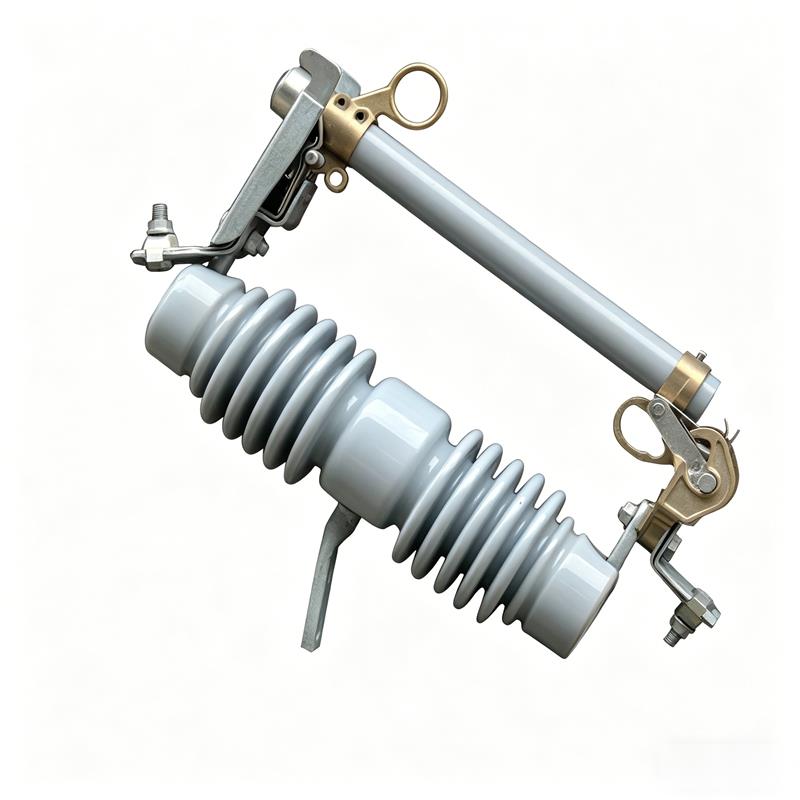
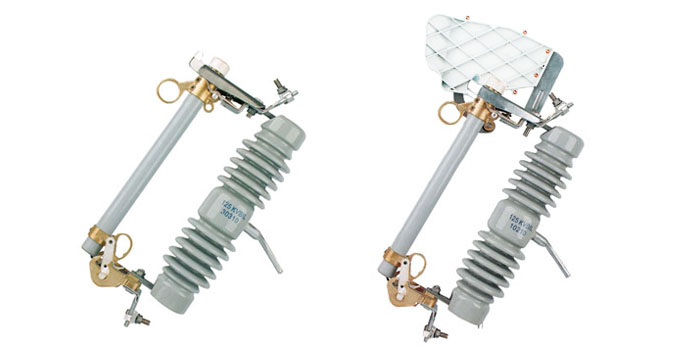
The 11kv drop-out fuse is an outdoor high-voltage protection device installed on the high-voltage side of 10kV distribution transformers or on branch trunk lines of distribution lines. It serves as a commonly used short-circuit protection switch for short-circuit and overload protection of transformers and lines, as well as for making and breaking load currents. It consists of an insulating support and a fuse tube. The fixed contacts are installed at both ends of the insulating support, and the moving contacts are installed at both ends of the fuse tube. The fuse tube is composed of an inner arc-extinguishing tube and an outer epoxy fiberglass tube. Load-break drop-out fuses are equipped with resilient auxiliary contacts and an arc chute for making and breaking load currents.
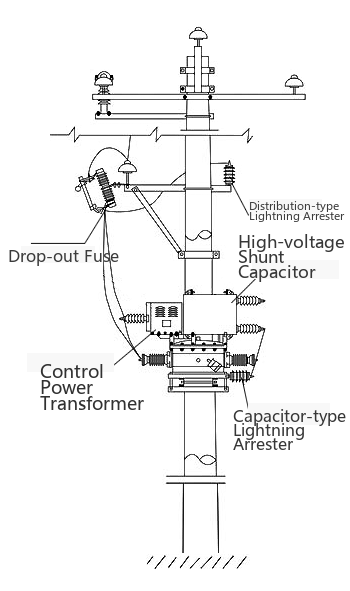
Drop-out fuses installed on branch lines of 10kV distribution lines can reduce the scope of power outages. Because they provide a clear disconnection point for a high-voltage drop-out fuse, they also function as disconnectors, creating a safe working environment for line and equipment maintenance and increasing the safety of maintenance personnel. When installed on distribution transformers, they can serve as the primary protection for the transformer. Therefore, they have become widely popular in 10kV distribution lines and distribution transformers. They are economical, easy to operate, and highly adaptable to outdoor environments, and are widely used on the primary side of 10kV distribution lines and distribution transformers for protection and equipment switching operations.
During normal operation, the fuse tube is held in the closed position by the tension of the fuse element. When a fault occurs in the system, the fault current causes the fuse element to melt rapidly, creating an arc. The arc-extinguishing tube, subjected to the intense heat of the arc, decomposes a large amount of gas, creating high pressure inside the tube, which is blown longitudinally, rapidly elongating and extinguishing the arc. After the fuse element melts, the lower moving contact loses tension and flips downward, and the locking mechanism releases the fuse tube, which then drops, forming a clear disconnection position. When it is necessary to break the load, an insulating pole is used to operate the contact. At this point, the main moving and fixed contacts are still in contact. As the insulating pole continues to pull the contact, the auxiliary contacts also separate, creating an arc between them. The arc is elongated in the narrow slot of the arc chute, and the arc chute generates gas, extinguishing the arc at current zero.
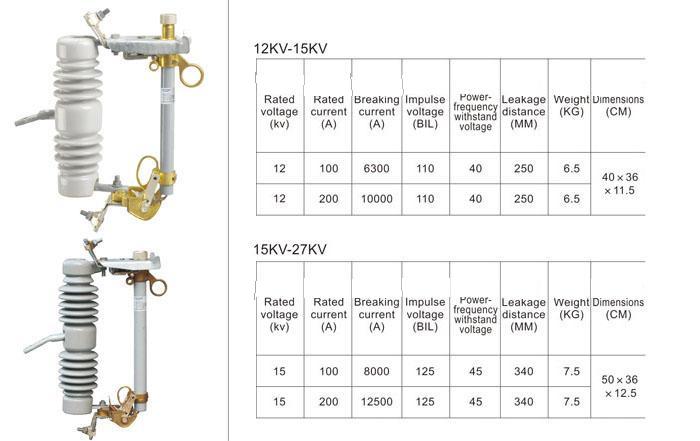
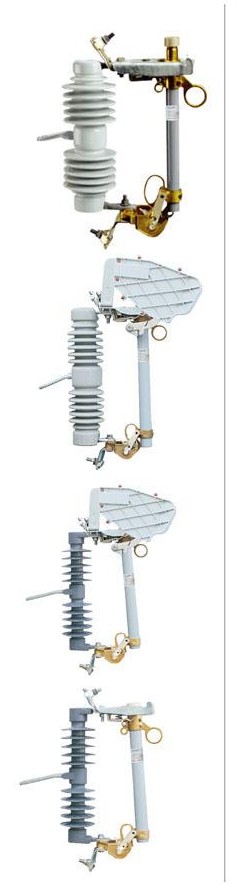
| Rated voltage (kv) | Rated current (A) | Breaking current (A) | Impulse voltage (BIL) | Power-frequency withstand voltage | Leakage distance (MM) | Weight (KG) | Dimensions (CM) |
| 24 | 100 | 8000 | 150 | 65 | 540 | 10 | 60×38×16 |
| 24 | 200 | 125000 | 150 | 65 | 540 | 10 | 60×38×16 |
| Rated voltage (kv) | Rated current (A) | Breaking current (A) | Impulse voltage (BIL) | Power-frequency withstand voltage | Leakage distance (MM) | Weight (KG) | Dimensions (CM) |
| 15 | 100 | 8000 | 125 | 45 | 340 | 8 | 58×40×15 |
| 15 | 200 | 125000 | 125 | 45 | 340 | 8 | 58×40×15 |
| Rated voltage (kv) | Rated current (A) | Breaking current (A) | Impulse voltage (BIL) | Power-frequency withstand voltage | Leakage distance (MM) | Weight (KG) | Dimensions (CM) |
| 15 | 100 | 8000 | 125 | 45 | 340 | 6.5 | 50×38×12.5 |
| 15 | 200 | 12500 | 125 | 45 | 340 | 6.5 | 50×38×12.5 |
| Rated voltage (kv) | Rated current (A) | Breaking current (A) | Impulse voltage (BIL) | Power-frequency withstand voltage | Leakage distance (MM) | Weight (KG) | Dimensions (CM) |
| 15 | 100 | 8000 | 125 | 45 | 340 | 6.5 | 50×38×12.5 |
| 15 | 200 | 12500 | 125 | 45 | 340 | 6.5 | 50×38×12.5 |
The 11kv export type drop-out fuse, as a critical 10kV outdoor high-voltage protection device, requires selection strictly based on system parameters. Its main technical parameters include rated voltage, rated current, breaking capacity, and impulse withstand voltage. Correctly selecting the 11kv drop-out fuse is crucial to ensuring the safe and stable operation of distribution lines and transformers. The following table lists the key technical parameters of common models for user reference in selection.
| Parameter | Unit | Typical Value |
|---|---|---|
| Rated Voltage | kV | 12 |
| Rated Current | A | 100 |
| Rated Breaking Current | kA | 6.3 |
| Lightning Impulse Withstand Voltage (Peak) | kV | 75 |
| 1min Power Frequency Withstand Voltage (Wet) | kV | 42 |
| Fuse Tube Mechanical Life | times | 2000 |
The 11kv export type drop-out fuse is mainly used in 10kV distribution networks. Its core advantages are economy, practicality, and convenient operation. As a short-circuit protection switch, it is widely used in the following scenarios:
This 11kv drop-out fuse has a simple structure and strong adaptability to harsh outdoor environments, making it an indispensable protection and operating device in 10kV distribution networks. Through the proper application of this high-voltage drop-out fuse, the safety and economy of the distribution system can be significantly improved.
11kv_Export Type Drop-out Fuse_10kV Outdoor High-Voltage Protection

Telephone

Online Service

Follow Us


TikTok

Back to Top